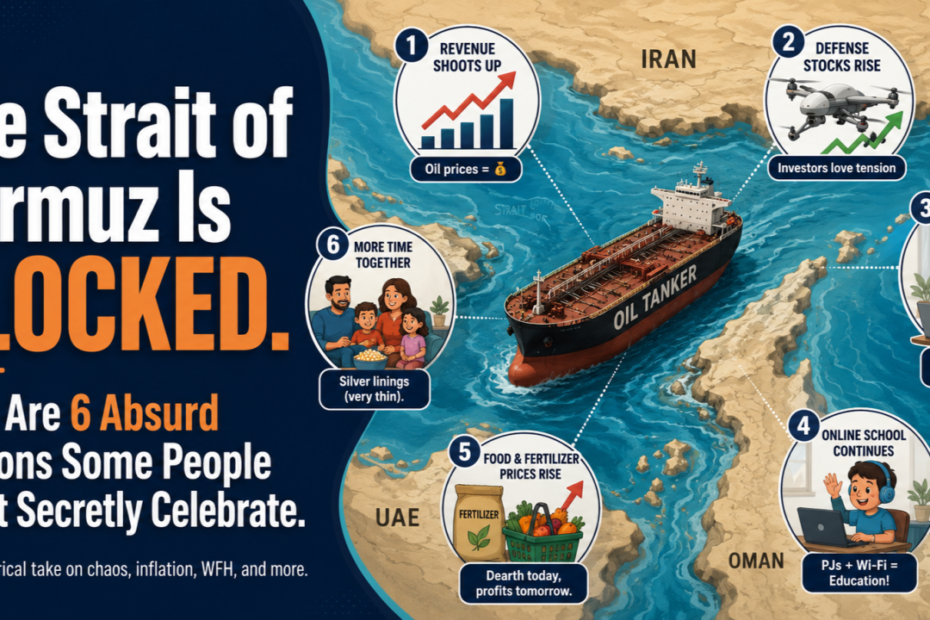
The US President’s historic visit to China has just wrapped up, and both sides have announced a long list of deals, discussions, understandings, handshakes, statements, and carefully worded diplomatic sentences.
But one small thing was missing.
A reopening date for the Strait of Hormuz.
You know, that tiny waterway through which a serious chunk of the world’s oil moves.
I was waiting for this announcement with the intensity of a man who pre-booked a non-refundable holiday to the Strait of Hormuz.
But then I thought…
Maybe everyone forgot to reopen it.
And maybe that is not entirely bad.
In fact, here are the top 6 “benefits” of the Strait of Hormuz blockade that nobody is brave enough to talk about.
1. Record revenue growth for companies
As fuel prices rise, transportation costs rise.
As transportation costs rise, product prices rise.
As product prices rise, company revenue rises.
Simple mathematics.
Earlier, a company sold 1 million products at price X.
Now, thanks to global chaos, it sells the same 1 million products at X + Y.
Result?
Record revenue.
Investors will call it “strong top-line growth.”
Customers will call it “why is toothpaste now a luxury item?”
Economists will call it “inflationary pressure.”
Management will call it “excellent performance in a challenging macroeconomic environment.”
Everyone wins.
Except the customer.
But that is a minor detail.
2. Defense stocks are having their fitness transformation
Defense stocks are not just rising.
They are doing CrossFit.
Suddenly, every country has discovered that defense matters.
The same people who once said, “Why spend so much on defense? Spend it on education, hospitals, and welfare,” are now asking:
“What is our national drone strategy?”
“Where are our domestic defense startups?”
“Why are we still depending on foreign suppliers?”
“Can someone please build a military-grade drone in my garage by Monday?”
The world has finally learned an important lesson:
Global supply chains are very reliable.
Until they are not.
3. Work from home is back — but now it is patriotic
This may be the greatest gift of the Strait of Hormuz to office employees.
After COVID, employees fought for work from home.
Management resisted.
HR said: “We believe in collaboration, culture, and physical presence.”
Translation: “We bought expensive office furniture and now someone must sit on it.”
But with fuel prices rising, the same HR department may soon send a new email:
“In the national interest, employees are encouraged to work from home where possible.”
Beautiful.
Yesterday it was laziness.
Today it is patriotism.
If your company still refuses work from home, don’t worry.
Wait until the finance team sees the monthly fuel reimbursement claims.
Suddenly, your laptop at home will become a symbol of national resilience.
And if HR still wants everyone in the office?
Simple solution.
Gift every employee a Tesla.
Then proudly say, “We support sustainable commuting.”
4. Online schooling will make a comeback
Somewhere, schoolchildren are quietly watching the news and asking:
“Does this mean Zoom classes again?”
During COVID, kids tasted a magical world.
No uniforms.
No school bus.
No morning rush.
No polished shoes.
Just waking up 3 minutes before class, joining online, camera off, biscuit in hand, and pretending the Wi-Fi is unstable during difficult questions.
If fuel prices continue rising, children may soon rediscover the ancient art of online education.
Teachers will call it “remote learning.”
Parents will call it “please no, not again.”
Kids will call it “best geopolitical development of the year.”
5. Fertilizer prices may become the new horror movie
When fuel and natural gas prices rise, fertilizer costs can also rise.
And when fertilizer costs rise, food prices rise.
The farmer suffers first.
The customer suffers last.
And everyone in between explains it using charts.
Soon, onions may need their own EMI plan.
Tomatoes may be sold with insurance.
And coriander may be treated like a premium add-on.
“Would you like coriander with that?”
“Yes.”
“That will be $4 extra and a soft credit check.”
The poor animals, of course, have no idea where the Strait of Hormuz is.
They don’t know geography.
They don’t follow oil markets.
They don’t read Reuters.
But somehow, as usual, they may still end up paying the price for human decisions made thousands of kilometers away.
6. Family life may improve again
Last time the world locked down, families rediscovered each other.
Some discovered love.
Some discovered patience.
Some discovered that their spouse chews very loudly.
But still, people spent more time together.
Board games returned.
Cooking returned.
Family conversations returned.
And yes, in some parts of the world, population charts also got a little excited.
Now, if fuel gets expensive and people travel less, we may once again see families spending more time at home.
Parents will say, “This is quality family time.”
Children will say, “Can we go out?”
Fathers will say, “Petrol is expensive.”
Mothers will say, “Then at least help with the dishes.”
And everyone will suddenly remember why commuting was invented.
So yes, while diplomats are busy discussing trade, sanctions, energy security, and regional stability, I am just sitting here appreciating the hidden benefits of global uncertainty.
Higher prices.
Record revenues.
Defense spending.
Work from home.
Online schooling.
Family bonding.
Who knew one blocked strait could do so much?
Of course, for the sake of the global economy, fuel prices, food security, shipping, inflation, and everyone’s sanity, I sincerely hope the Strait of Hormuz opens soon.
But until then, let us at least acknowledge its contribution to modern management thinking.
Because nothing drives innovation like panic.
And nothing brings back work from home faster than petrol becoming a luxury product.
Anyway. Back to checking fuel prices.
For research purposes.
Yes, if this made you smile and you’d like a few more laughs, my new book, How to Be Your Dog’s Personal Assistant, is now live on Amazon.
With one click, you can have it delivered straight to your phone or Kindle.
And if you belong to the traditional school of readers who believe a book must be touched, smelled, and occasionally used as a coaster, don’t worry — it’s also available in paperback.
Read One Article and Still Hungry?
Binge my other masterpieces before they become required reading in future history books. Check out my other articles on LinkedIn, — because knowledge is power, and laughing while learning is a superpower.
Support My Caffeine Addiction (And Future Articles)!
If this article made you chuckle, nod in agreement, or dramatically rethink your life choices, consider buying me a coffee! It fuels my writing, keeps my humor intact, and prevents me from selling my books for snacks. Buy me a coffee here!