When I was a kid, I read this gripping book about four men who accidentally land on an island. At first, they struggle to survive, but then they start enjoying their new life, discovering hidden secrets, and blah blah blah — it was the kind of book that made my tiny brain think, Wow, maybe I could be a writer!
Fueled by this revelation, my teenage writer self did five imaginary pull-ups, gathered an unreasonable amount of confidence, and proceeded to write what I was sure was a brilliant, extraordinary, best-selling, thought-provoking ( ___, ____, ___insert more flattering adjectives here) short story. I was convinced Hollywood would turn it into an Oscar-winning masterpiece.
Well… turns out, my literary genius was not as obvious to my conservative Indian father, who, after considerable effort, managed to say, “Good try! Maybe next time you can write even better.” (Translation: Beta, this is nonsense.)
But I was a teenager, and you know how teenagers view their parents’ advice — complete garbage. So, instead of taking the feedback like a rational human, I thought, This world does not deserve my magnificent writing. I shall never grace its unworthy pages again!
Fast forward a few years, and instead of penning literary gold, I found myself writing thrilling pieces of work such as circuit test reports and edge-of-your-seat research papers for the engineering world. (Spoiler: No one won an Oscar for reading those.)
But then, one day, something magical happened — an inspiration struck. I’ll save that story for another time, but let’s just say my inner writing beast woke up from hibernation, stretched a little, and decided to get back to work. Over the past seven years, I’ve written six high-content books on topics ranging from self-help and interview skills to handling infidelity. On top of that, I’ve published over 70 low- and medium-content books, including children’s storybooks, just to satisfy my writing obsession.
Not too bad for someone who once struggled so badly with English that my parents paid actual money for grammar tuition. My friends laughed at me — “Hah, this guy takes English tuitions!” — but hey, maybe those lessons paid off. At least, they gave me a personal mantra that has helped me survive:
“Your English is not pathetic. English itself is pathetic.”
Need proof? Here are my top three reasons:
- In English, you “fill in” a form by “filling it out.”
- You drive on a parkway but park in a driveway.
- “Read” (past) and “read” (present) are spelled the same, yet pronounced differently.
Honestly, this kind of linguistic nonsense has allowed writers like me to blend in, getting lost in the glorious mess of the English language.
Anyway, enough about my tragic English journey. If you’ve read this far, congratulations! You now understand just how shitty my writing is. And if you’re still here, that means you’re brave enough to read the writing advice I’m about to unleash.
So, if you’re ready to endure my 10 hard-earned writing rules, please proceed. And if you make it through all 10, I’ll throw in 5 bonus rules that I absolutely just made up — because, honestly, who can resist creating their own rules?
1. Write Every Day (Or Don’t. No One’s Watching)
They say to become a successful writer, you must write every day. But let’s be honest, no one is standing over your shoulder, taking attendance. So, I prefer my own, more flexible rule: Write every day… unless it’s a Wednesday, or you have writer’s block, or the Wi-Fi is down, or the neighbor’s dog is being too loud.
And if you do hit writer’s block, don’t bang your head against the keyboard — it won’t help (I’ve tried). Just go out and grab a coffee… or, depending on the time of day, a beer. Actually, beer works better than coffee — one glass, and suddenly, you’ll have a flood of brilliant ideas. The only problem? You won’t remember any of them in the morning.
2. Don’t Overuse Adverbs (Unless You’re Feeling Rebellious)
“Don’t use too many adverbs!” they warned me on Medium. But honestly, I literally, absolutely, totally cannot write without them. Sometimes, an adverb is just what you need.
Sure, saying “She ran quickly to the store” is a crime against literature. But in my Indian accent, adverbs are built into my soul — removing them would be like removing spice from Indian food. My mantra? What is writing if not a rebellion against grammatical norms? You do you, adverbs.
3. Show, Don’t Tell (But Sometimes Tell, Because Showing is Hard)
Every writing course will tell you: “Show, don’t tell!” But listen, we’re not all Michelangelo with words. Sometimes, I don’t want to paint an emotional masterpiece — I just want to tell you exactly what’s happening and move on with my life.
For example, I could write:
“Her world crumbled as she stared at the shattered glass, her hands trembling as realization set in.”
Or, I could just say:
“She was having a breakdown, but it was fine.”
Both work. My mantra? Write straight to the point. If possible, use bullet points.
4. You Must Have a Detailed Plot (Or Just Let the Characters Figure It Out)
They say every story needs a detailed plot outline. Great advice — unless you write non-fiction like me. What am I supposed to outline? My life mistakes?
Even when I’ve written detective stories, plotting felt like trying to plan a vacation without knowing the destination. I find it much easier to just throw my characters into chaos and see what happens. It’s like real life — messy, unexpected, and somehow, it all works out in the end.
5. Your First Draft is Going to Be Trash (But At Least You Did Something)
Writers love to say, “Your first draft is always bad.” What they don’t tell you is that your second draft will also be bad. And your third. And possibly your fourth.
So, here’s my rule: Write as many drafts as you want. There’s no deadline. Just don’t take J.K. Rowling’s 14 rejections too seriously, or you’ll never even try to self-publish.
Take me as an example — I wrote my first book in 15 days. No editing, no rewrites, just pure overconfidence. Then I bragged to my friends that I was a published author. (Of course, years later, when I actually learned how to write, I quietly removed that book from Amazon.) But hey, that’s a story for another post.
6. Don’t Compare Yourself to Other Writers (Except When You Do)
They say “Never compare yourself to other writers.” Yeah, good luck with that.
Every time I open social media, I see some writer posting: “Just finished my second novel this month! Now onto my screenplay!” Meanwhile, I’ve spent three hours debating whether “that” or “which” sounds better in a sentence.
So, here’s my rule: Compare yourself to other writers — but only for 10 minutes. Feel bad about yourself. Then, turn that self-pity into motivation. Channel your inner competitor. Compete, don’t just compare. Because if you don’t, you might never finish your draft.
7. Avoid Clichés (Unless They’re Actually Kind of Fun)
Every time I hear someone say “avoid clichés,” I can’t help but wish they were saying “avoid clutches” — because those are what actually drain my credit card every month. (Not because I buy them, but because I pay for them. A crucial distinction.)
For my fellow vocabulary-challenged folks, here’s a refresher:
A cliché is a phrase or idea that has been used so many times, it’s lost its originality. Examples include:
- “Time heals all wounds” (Debatable. Ever tried forgetting a bad haircut?)
- “Easy as pie” (Have you ever tried baking a pie? LIES. Any cooks reading this who can vouch this for me?)
- “Don’t play with fire” (Where’s the fun in that?)
Writers hate clichés because they’re lazy and predictable. But let’s be honest — sometimes clichés are comforting. If I can’t say “light at the end of the tunnel” every now and then, then what’s the point of writing at all?
Thank goodness someone allowed clichés for comedic effect — otherwise, I’d have been booted from the writing community ages ago.
8. The 3-Act Structure is Sacred (But I Like 7 Acts, Thank You Very Much)
If you’re a non-fiction writer and wondering what the 3-act structure is, congratulations! You’re as lost as I was. Basically, it’s a storytelling formula that divides a story into:
- Setup (Introduce characters, settings, and problems)
- Confrontation (Things get messy. Crying or panic attack may happen.)
- Resolution (Tie up loose ends or leave readers screaming at an unresolved cliffhanger.)
Sounds simple, right? But what if you’re like me and enjoy a little chaos? What if you get halfway through your book and think, Why stop at three acts when I could have seven?
More acts = More drama.
More drama = More coffee required.
More coffee = Less sleep.
Less sleep = A truly immersive writing experience.
So if you’re feeling rebellious, forget the 3-act structure and create your own 9-Act, 15-Act, or 37-Act monstrosity. Who’s stopping you? (Other than your future editor.)
9. Character Development is Key (Unless They’re a Werewolf, Then Just Make Them Cool)
Writers love to say that character development is everything. And they’re right — unless your character is a werewolf, vampire, or some other supernatural hottie.
For regular humans, you need pages of backstory:
- What were their childhood traumas?
- Why do they avoid eye contact?
- What’s their go-to karaoke song?
But for werewolves? Just make them ridiculously attractive, throw in a tragic backstory, and BOOM — bestseller.
Nobody is picking up a vampire romance novel to read about Count Drac’s emotional growth. They just want to know how many abs he has and whether he broods by moonlight.
Character depth is great. But let’s not pretend every reader wants a novel-length therapy session.
10. Editing is Where the Magic Happens (But Also, Where You Die Inside)
Editing is where your dreams go to be mercilessly slaughtered.
People say “Editing is where the magic happens!” but they never mention that the magic is also painful.
- You’ll cut out sentences you once thought were pure genius.
- You’ll realize that half your metaphors don’t make sense.
- You’ll rewrite the same paragraph 17 times.
Editing isn’t just about polishing your work — it’s about killing your darlings, one unnecessary adjective at a time. It’s brutal. It’s soul-crushing. It’s the reason many writers take up drinking. (Not me, I started writing very late!)
But hey, if you survive it, your writing might actually be readable.
And now, as a reward for making it this far, here’s a bonus just for you — 5 Writing Rules I Completely Made Up On the Spot, but I guarantee they work… on a $0 stamp paper. (Because who needs legal backing when confidence is free?)
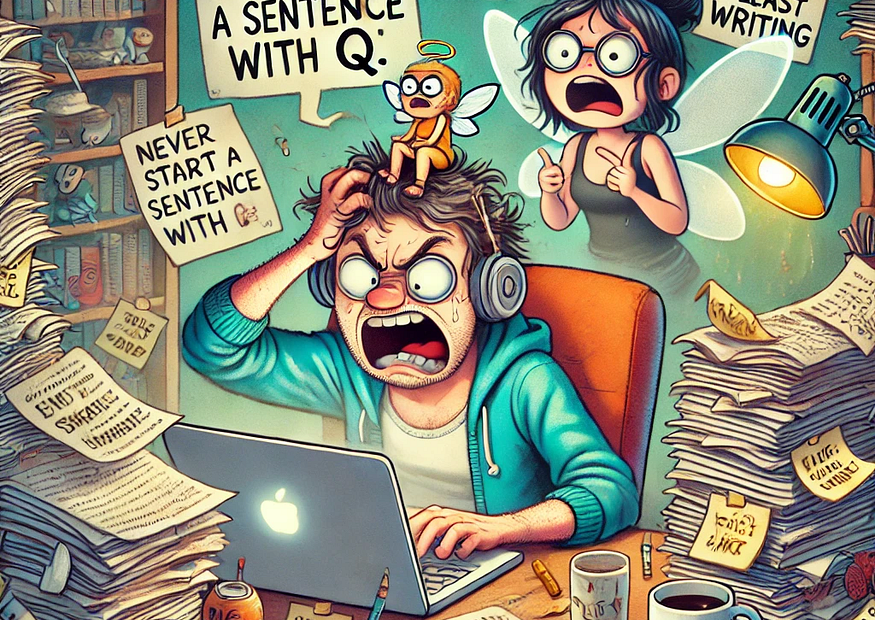
1. Never Start a Sentence with the Letter “Q.”
It is purely an aesthetic choice and no non-sense. No sentence starting with “Q” has ever sounded natural. If you can think of one, I’ll reconsider — but I stand by my rule.
2. If You’re Not Crying After Writing a Scene, You’re Doing It Wrong.
It doesn’t matter if you’re writing a rom-com or a thriller — if you didn’t get emotionally wrecked at least once, did you even write? Come on, grow up. (Or don’t. I’m not here to tell you how to live your life.)
What’s the fun in dry, emotionless writing? Learn to sprinkle some wet emotions! It’s free, after all — you’re not getting a separate water bill for it.
3. You Can’t Call Yourself a Writer Until You’ve Deleted at Least 200 Words.
I don’t make the rules, I just enforce them. If you haven’t rage-deleted half of your novel at least once, are you even serious about this? How dare you call yourself a writer then!
4. Your Characters Should Have a Backstory So Intricate It Requires a Spreadsheet.
Go ahead. List their childhood pets, their favorite snack, and the exact moment their trust issues developed. Will you use this information? No. But does it make you feel professional? Absolutely.
5. If You Don’t Feel Slightly Guilty About Taking a Writing Break, You’re Probably Not Writing Enough.
Every writer needs a break. But if you don’t feel guilty about it, then are you even procrastinating properly?
Final Thoughts
So there you have it — 10 totally legitimate (and 5 totally questionable) writing rules.
At the end of the day, the best writing advice is:
✔ Write if you want.
✔ Take breaks when you need to.
✔ And ignore half the advice you read online (except mine, obviously).
Now, go forth and break every writing rule you’ve ever learned — it’s what all great writers do.
And here is a shameless begging — If you liked this article, please clap and leave a comment. That way I will be motivated to write more shitty articles in future!
🤓 Read One Article and Still Hungry?
Binge my other masterpieces before they become required reading in future history books. Check out my other articles on LinkedIn, because knowledge is power, and laughing while learning is a superpower.
☕ Support My Caffeine Addiction (And Future Articles)!
If this article made you chuckle, nod in agreement, or dramatically rethink your life choices, consider buying me a coffee! ☕ It fuels my writing, keeps my humor intact, and prevents me from selling my books for snacks. Buy me a coffee here! 🚀